Builds
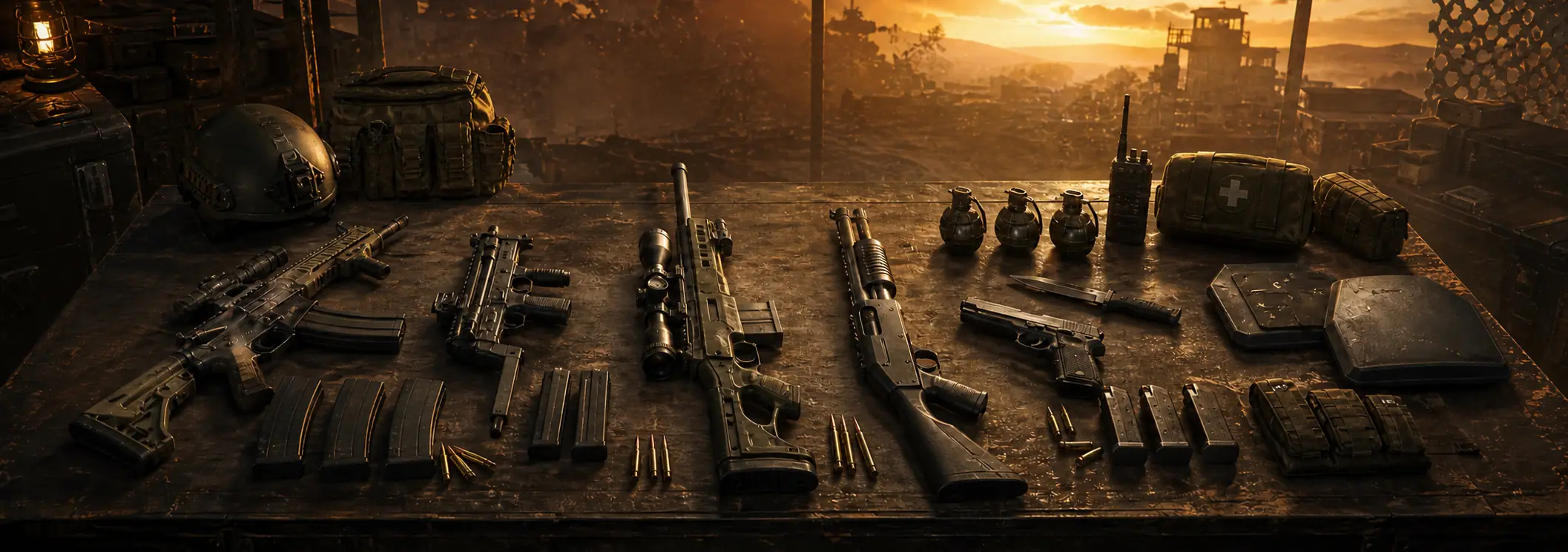
WARDOGS loadouts
You start with $10,000 and buy a kit before every life — from a balance that carries between matches, so what you lose stays lost. These are the builds worth spending it on, organised by what they cost, because that is the decision you actually make.
Interactive tool
Loadout planner
Build the kit, watch the bill and the carried weight total as you go, and read the movement penalty band your weight puts you in. Every build shares as a link.
Open the planner →
Community builds
Best loadouts
Kits other players have published, priced and weighed against the same catalogue the planner runs on, and ranked by what the board votes up. Open any of them straight into the planner.
Browse the hub →What is the best loadout in WARDOGS?
It is answerable now, and a month ago it was not. Bulkhead has still never published the cost of a single weapon — but between the alpha vendor and the game's own data, 33 of 33 weapons and every piece of gear carry a recorded price on this site. The AMR 50 runs to $8,800; a halftrack backpack costs $15,000, half again the balance you are given. The arithmetic that was impossible in July is one page away — the planner totals any kit against the $10,000 you get once.
What can be worked out now is how to think about spending, and in a game with a persistent balance that matters more than any individual build.
Why a normal tier list is the wrong tool
A tier list assumes your gear is free and resets each match. Neither is true here. You are given $10,000 once, per account. Spend it and lose it, and it is gone — there is no per-match reset that hands it back.
So the question is never "what is the strongest kit". It is what is the most effective kit I can afford to lose repeatedly, given how the match is going and how much is left. That is a bankroll problem, closer to Counter-Strike's buy rounds than to a Battlefield class menu — except the bankroll never resets.
The three spending bands
Our framing, not Bulkhead's — a way to organise builds once prices exist, based on the confirmed $10,000 balance:
| Band | Spend | When it is the right call |
|---|---|---|
| Budget | up to $4,000 | What you can field after a bad life. |
| Standard | up to $7,500 | The everyday spend. |
| Full budget | up to $10,000 | Everything a fresh spawn can afford. |
The bands matter because of what a bad run does to you. Lose three full-budget kits in a row and you are not just behind on the scoreboard — you are priced out of competing for the rest of the session, while the player who spent carefully still has options.
You earn by playing the objective, not by fragging
Income is confirmed to come from teamplay: reviving, transporting squadmates, spotting and holding objectives all pay. Two consequences follow.
- A support build can out-earn a killer. If a cheap kit with medical or transport gear generates more income than an expensive rifle does, the cheap kit is the better economic play regardless of how it feels.
- Dying poor is recoverable; dying broke is not. The floor matters more than the ceiling. Keeping enough back to field something useful next life is worth more than marginal power this life.
Role is not fixed. There are no classes — you define what you are each life by what you buy, and six XP tracks reward using specialist gear rather than pre-selecting a role. Medic and Pilot are the two publicly named; the other four have not been announced.
What we still do not know
- The last 0 weapon prices — the , which no capture has caught at a vendor yet
- Whether any cash or equipment is recovered on death
- What each scoring action pays, so nobody can calculate a break-even yet
- Whether the $10,000 is ever topped up if a player is wiped out
- How Gold Bars and the Gold Market interact with the standard balance
The prices arrived because the embargo that kept them off this page lifted — the terms are here. What is left is the part no vendor screen settles: what a revive or a held objective actually pays. That is measured in play rather than read off a price tag, and until somebody measures it, the break-even between a cheap kit that earns and an expensive one that does not stays an argument rather than a number.
Related: the weapon catalogue and how costs are judged, why cost is the WARDOGS meta, and the cash economy explained.
Not available yet
The prices landed. The builds are what is missing.
Everything a kit is made of now carries a recorded price — 33 of 33 weapons and every piece of gear. What is not here yet is the builds themselves: costed kits with a case for why each part earned its slot. The planner above prices anything you assemble today, and the loadout hub is where published builds land.
What will be here
- Complete builds priced against your cash balance
- Budget, standard and full-spend versions of each role
- What each build gives up to afford its centrepiece
- Anti-vehicle, pilot, medic and long-range specialisations
- Community builds promoted from the loadout hub, credited to who built them
- Rebuilt after every patch that moves a price
We would rather hold an empty page than fill it with guesses.The Closed Beta runs 21–23 August →
How builds will be organised
By price band first, role second — because in WARDOGS what you can afford comes before what you want.
Budget
≤ $4,000
What you can field after a bad life.
Standard
≤ $7,500
The everyday spend.
Full budget
≤ $10,000
Everything a fresh spawn can afford.
Where to go from here
Catalogue
Every calibre and what it costs
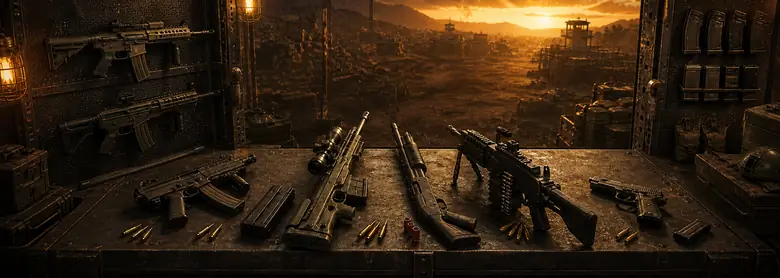
Box prices, per-round costs for all three loads, and which weapons chamber each.
Catalogue
Equipment, priced piece by piece
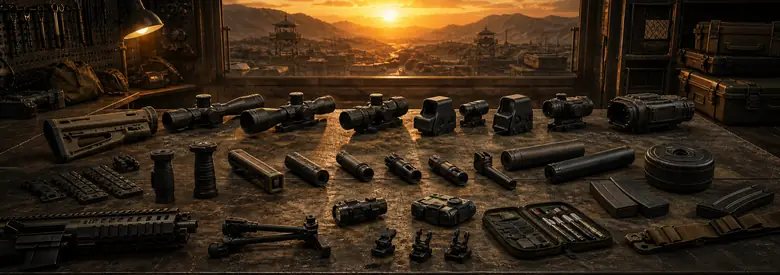
Grenades, stims and deployables — what a vendor sells and what the game holds back.

Catalogue
All 20 vehicles, and what gates them
Three price tags, two cash unlocks, and three separate level tracks.
Tier list
Why cost is the WARDOGS meta
A weapon that wins fights can still be the wrong buy.