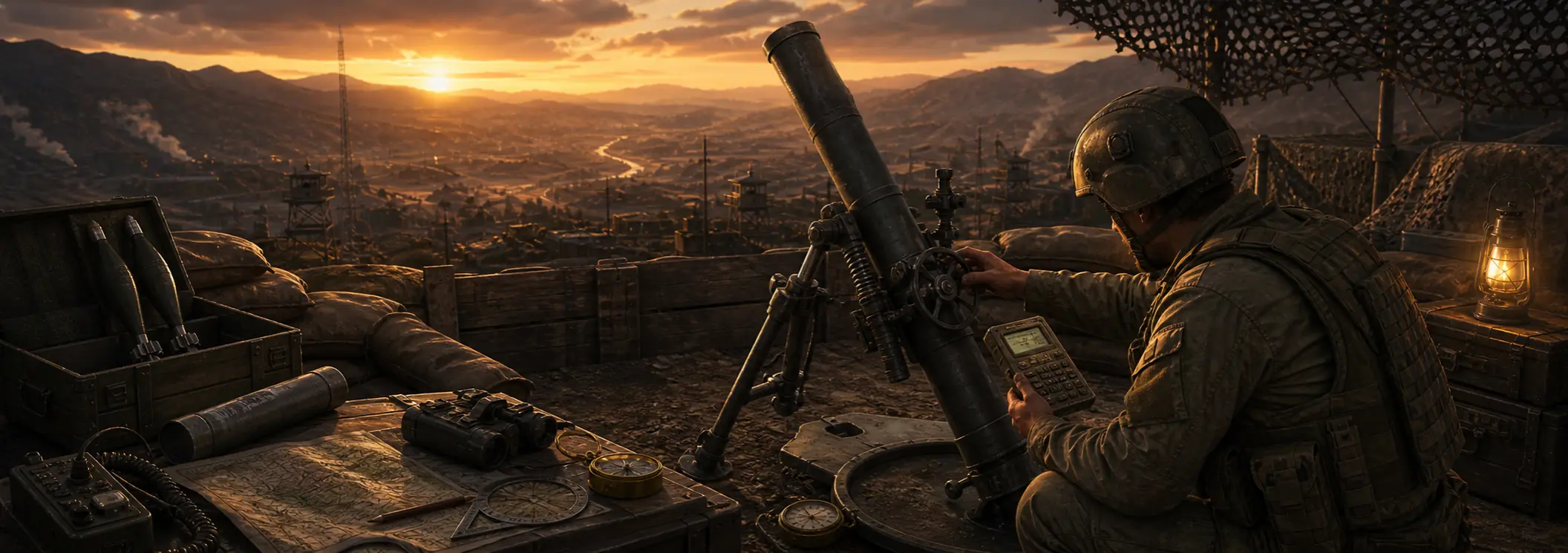
Indirect fire
WARDOGS mortar & artillery calculator
Quick mortar & artillery calculator
How to fire it
- Open the map, right-click your gun and the target, choose Mark Coordinates, and type both grids above.
- Ping the target and turn the tube until the ping's diamond is centred on your compass, or traverse to the bearing shown.
- Dial the range shown on the RNG scale. It already allows for the height difference.
- Fire one ranging round, watch it land, correct one value at a time, then fire for effect.
Place your gun on the map, mark where you want the shell to land, and get the bearing, sight range and mils you need to hit it. This WARDOGS artillery calculator, also used for arty and indirect fire (IDF), covers both the SPH-2 and the L81 mortar.
WARDOGS mortar & artillery map
Place your gun and targets on the real terrain of every map, and get height-corrected solutions for the whole battery.
Site your first gun.
Click the map to place a gun, or enter
its coordinates in the battery panel.
Click to place, drag to adjust, scroll to zoom. On a phone, tap the map to open it full screen. Copy board link shares your battery and targets.
How to use artillery →Browse the terrain →Does this match what you see in game?
Goes to us, not to the page
If you have fired a round, tell us how the shell landed against the sight settings. Your selected weapon, distance and elevation are attached to the report.
How far can the L81 mortar and the SPH-2 shoot?
- SPH-2 artillery: range up to 2.66 km
- Buildable L81 mortar: range up to about 685 m
Plan shots on the real terrain of Bakurani, Ozeti and Zestafona. The calculator accounts for the height difference between gun and target, so the firing solution you read is already corrected.
SPH-2
Reported- Range, level ground
- 745–2,660 m
- Target 100 m higher
- 735–2,587 m
- Target 100 m lower
- 754–2,730 m
- Sight
- 0–1400 mil
- Trajectories
- Low and high
- Shell
- 155 mm Standard
- Reload
- 27 s
- Grouping
- 10 MOA
Two trajectories. The low arc reaches from about 1,070 m out to maximum range and gets there fast; the high arc covers the whole envelope, and nearer than about 1,070 m on level ground it is the only one that reaches. Both close on the same elevation at the far end.
L81 Mortar
Reported- Range, level ground
- 52–685 m
- Target 100 m higher
- 48–623 m
- Target 100 m lower
- 55–736 m
- Sight
- 120–950 mil
- Trajectories
- High only
- Shell
- 120 × 800 mm
- Reload
- 6.5 s
- Grouping
- 50 MOA
One trajectory, so one solution per distance. It is a lobbed shot at every range — 17.4 s in the air at 400 m — which makes the mortar a weapon for targets that stay put.
How do you use the WARDOGS artillery and mortar calculator?
- Pick the theatre and the gun. Choose the map above the board, then the SPH-2 or the L81 mortar. Each gun on the board keeps its own type.
- Site the gun. Click the map where it stands, or type the game's X and Y into the battery panel — or paste a pair a squadmate sent you. A battery holds up to eight guns.
- Mark the target. Click it on the map or enter its coordinates. Up to 24 targets stay on the board; select one in the list, or press its number, to solve for it.
- Read the solution and fire one. Turn to the azimuth, dial the sight range or the mils for the arc you want, and fire a single ranging shell.
- Correct from where it landed. Drag the target marker onto the impact and read the difference, then fire for effect.
How do you read a mortar firing solution?
The numbers do different jobs.Azimuth is a compass bearing from the gun to the target, so 0° is north and 90° is east — it is the number you traverse to.Ground range is the horizontal distance between the two, there so you can sanity-check the rest against what you can see.
Each arc then gives three settings. Sight range is the range to set on the gun: the distance that elevation would carry on level ground. On flat ground it matches the ground range; firing uphill it reads longer, and downhill shorter, because the elevation already carries the height difference. Mil is the same setting on the gun's own sight scale, and flight time is how long the shell is in the air.
The dashed rings around the selected gun are its level-ground envelope: the outer one is maximum range, and the shaded one is the minimum it can shoot inside. Height moves both, so a target just outside a ring can still have a solution — the panel is the authority, the rings are the guide.
Where a platform can reach a target two ways you get two solutions. The low arc is the flatter shot: it arrives sooner and it is the one to use when the target might move. The high arc lobs the shell over whatever is in the way, which matters more than arrival time when the target is behind a ridge — and on level ground inside about 1,070 m it is the only SPH-2 trajectory that reaches at all.
Does height between the gun and the target change the shot?
Yes, and by more than people allow for. An SPH-2 at 1,500 m on level ground fires its low arc at 80 mil. Put the target 100 m above the gun at the same distance and the low arc needs 156 mil — a sight range of 1,830 m for a target 1,500 m away. Dial the level-ground solution there and the shell hits the hillside short of the target.
So the calculator reads the terrain under both positions and solves for the difference. The board shows Height corrected with the rise or drop beside it, and every sight range and mil value already includes it. It also samples the ground along the line of fire and marks an arc Terrain blocked when the shell would meet a ridge before the target; the flight profile under the solution draws both arcs over the ground so you can see where.
Heights come from the game's landscape on an 8 m grid, which moves a solution by a fraction of a mil. They are used only as differences between two points, never as an altitude above sea level. Where no terrain is available the board says Flat estimate rather than quietly solving on level ground.
How do WARDOGS map coordinates work?
The calculator speaks the game's own X/Y, so you can type what is on your screen straight into it, or paste a pair a squadmate sent you. One coordinate unit is 100 m, which makes 0.10 ten metres and 0.01 a single metre — so a pair quoted to two decimals is accurate to the metre, which is finer than any gun here shoots.
Y counts north, the way a map does: a target with a higher Y than your gun is further up the screen. Both axes run from 0 to 163.84 across the full terrain, and on Bakurani the readout a player sees covers roughly X 23.35–133.6and Y 19.34–129.65 inside that. The terrain extends past that box on every side; the coordinate grid does not.
On Ozeti the readout is provisional. Our terrain there is a different crop from the one the coordinates were calibrated on, offset by 162 m on each axis, and that shift has been measured against the terrain but not yet against the in-game map. Distance and bearing between two placed points do not depend on it; a typed or copied X/Y does. If you can read a coordinate off your screen on Ozeti, the feedback box under the tool is where a correction lands.
Which maps does the artillery calculator cover?
Bakurani is the surveyed one: the three faction spawns, the vendors and the towers are marked, so you can solve from a spawn to a tower without reading a coordinate at all. It is a river valley with forested ridges on both sides, which is exactly where the height correction earns its keep.
Ozeti carries the same marks and the same height correction, with the provisional coordinate readout described above.
Zestafona has terrain and heights but no surveyed positions and is not playable yet. Distance, bearing and height between two placed points are right; its X/Y readout is unverified until somebody reads a coordinate in game.
Why does a shell miss when the elevation is right?
ConfirmedBoth platforms have a grouping built into them, and it is wider than people assume. The SPH-2 holds 10 MOA and the mortar 50 MOA— an angle, so the faster it opens the further you shoot. The calculator shows it as Spread under every solution.
Mortar, near
±2.9 m
at 200 m
Mortar, far
±10.0 m
at 685 m
SPH-2, mid
±2.9 m
at 1,000 m
SPH-2, far
±7.7 m
at 2,660 m
A mortar at the far end of its reach puts shells across about ten metres whatever you dial. That is the difference between an infantry squad and an empty field, and it is why a first shell is a ranging shell rather than the shot. The angle itself is settled; what it measures is not — whether it bounds a radius, a full width or a typical spread is not something the numbers say, so read it as the scale of the error, not a guarantee.
How do you correct a shot that missed?
First decide whether it missed at all. Every solution on the board carries a Spread figure — about ±5.8 m for the mortar at 400 m, ±2.9 m for the SPH-2 at 1,000 m. A shell that lands inside it is the grouping doing what it does, and redialling after it only chases the dice. Fire again on the same settings.
When shells keep landing outside it on the same side, the error is in the gun, not the shell: a mis-typed coordinate, a target placed on the wrong rooftop, or — on the SPH-2 — a hull parked on a slope. Correct it like this:
- Mark where it landed. Add a second target on the board at the impact, from the shell camera or from what you saw.
- Read the impact's solution. Select it and note its azimuth and sight range. That is where the gun actually sent the shell.
- Apply the difference the other way. If you dialled 600 m and the impact reads 640 m, the gun carries 40 m long: dial 560 m. If the impact reads 2° right of the azimuth you laid, traverse 2° left. Mils work the same way on the arc you fired.
- Keep the correction while the gun stays put. A tilted SPH-2 is off by the same amount at nearby targets, so carry the offset to the next one rather than starting over. Move the vehicle and you start again.
Correct from two or three impacts rather than one where you can afford the shells: at the far end of the mortar's reach the grouping alone is wide enough to fake a 10 m error.
What does the calculator not account for?
Anything that is not the ground. The terrain check sees the landscape, not buildings, trees or anything players have built, so a clear arc over a town can still clip a roof. If the line of fire crosses structures, prefer the high arc.
Near the SPH-2's maximum — past about 2,600 m on level ground — the low and high arcs close on the same elevation, so a metre of extra range costs a lot of elevation and a small dialling error lands long or short. Do not fight for the last hundred metres; move the gun.
The generic 155 mm round resolves to the standard shell, which is what this table is taken to describe. A separately tagged expensive 155 mm exists and is a different projectile — a fifth of the mass and a fraction of the drag — so it will not share these numbers. Whether the SPH-2 can actually load it is unsettled; if it can, it needs its own table rather than this one.
The SPH-2 adds a second correction the numbers cannot make for you. It is a vehicle, and how it is parked changes where the barrel actually points: park it on a slope and the elevation you dialled is not the elevation you get. In the gunner's view, the two small markers either side of the vehicle silhouette show lateral tilt — get them level, and pick flat ground over a good firing position when the two disagree.
Both platforms are marked reported rather than confirmed: the trajectories come from a drag simulation calibrated against the game by the community, and they agree with the ranges the guns advertise, but nothing here has been published by Bulkhead. Nobody has established whether wind exists. Treat the first shell of any engagement as the one that tells you the truth.
Common questions
How far can artillery shoot in WARDOGS?
On level ground the SPH-2 reaches from about 745 m out to 2,660 m — about 2.66 km — and the L81 mortar from about 52 m to 685 m. Height moves both: an SPH-2 firing at a target 100 m below it reaches about 2,730 m, and at one 100 m above it about 2,590 m. None of these figures is published by Bulkhead.
What is the WARDOGS mortar’s maximum range?
About 685 m on level ground. Downhill it carries further — about 735 m to a target 100 m below the tube — and uphill it falls shorter, about 625 m to a target 100 m above. It fires the high arc only, dialled between 120 and 950 on its sight. Range your first shell rather than trusting any number, ours included.
Should you fire the low arc or the high arc?
Low when the target might move, high when something solid is in the way. The low arc spends less time in the air, so it is the one that catches a vehicle rather than cratering the road behind it. The high arc drops in steeply and clears a ridge. On level ground the SPH-2's low arc does not reach inside about 1,070 m at all, so under that distance the high arc is not a preference — it is the only trajectory that gets there. The calculator marks either arc that meets the terrain before the target.
Does the calculator work on Ozeti and Zestafona?
Ozeti, yes: pick it above the map and the spawns, vendors and towers are marked the same way as Bakurani's, with terrain height corrected on both. Its X/Y readout is provisional — our Ozeti terrain is a different crop from the one the coordinates were calibrated on, and the 162 m shift that reconciles them has not yet been checked against the in-game map — so read a coordinate off your own screen before you trust one from here. Zestafona has terrain and heights but no surveyed positions and is not playable yet: distance, bearing and height are right, the X/Y readout is unverified.
Can my squad use the calculator, and does it work on a phone?
Yes to both. Site up to eight guns and 24 targets, then Copy board link sends the whole board — battery, targets and drawings — to a squadmate. It is a snapshot rather than a live session, so send a new link after you move something. On a phone, tap the map to open it full screen; placing, dragging and pinching all happen there, and the board saves on your device between visits.
Do you need a calculator to use artillery in WARDOGS?
No, but the alternative is walking shells onto the target by eye, which costs rounds a mortar fed from a FOB’s ammo supply cannot spare. What a calculator cannot do is make the shell land where the maths says: both platforms have a grouping wide enough that the first shell of any engagement is a ranging shell, not the shot.
Credit
The spawn, vendor and tower positions on Bakurani and Ozeti, the measured firing tables the calculator was first built on, and the landscape heights behind its terrain correction come from wardogs-calculator, an open-source project by apollyon-sys, and are used under its MIT licence. What is ours here is the terrain render, the trajectory solver, the battery board and the shareable link — and the map glyphs, which are drawn rather than borrowed.
Next
How to use artillery in WARDOGS
Both platforms, which arc to fire, and why the shell still misses when the maths is right.
Why mortars took over WARDOGS
The shell camera, the three-round burst, and what counters the meta this calculator feeds.
SPH-2
The platform behind half this page — armour, crew and where it sits in the vehicle tree.
Bakurani
The surveyed map: spawns, vendors and towers marked, terrain height included.
Ozeti
Same terrain correction as Bakurani, with the provisional coordinate readout explained above.
All maps
Every WARDOGS map the site holds terrain for, including Zestafona.
WARDOGS tier list
Where the SPH-2 and the L81 mortar rank against everything else you can unlock.
Read next
Kolchia
The map and the Control Zone
256 km², with a 2 × 2 km zone that moves every match.
Catalogue
All 20 vehicles, and what gates them
Three price tags, two cash unlocks, and three separate level tracks.
Catalogue
Every weapon we have recorded
The Closed Alpha roster, tab by tab.
Builds
Complete loadouts by what they cost
Whole kits priced against the $10,000 you get once per account.