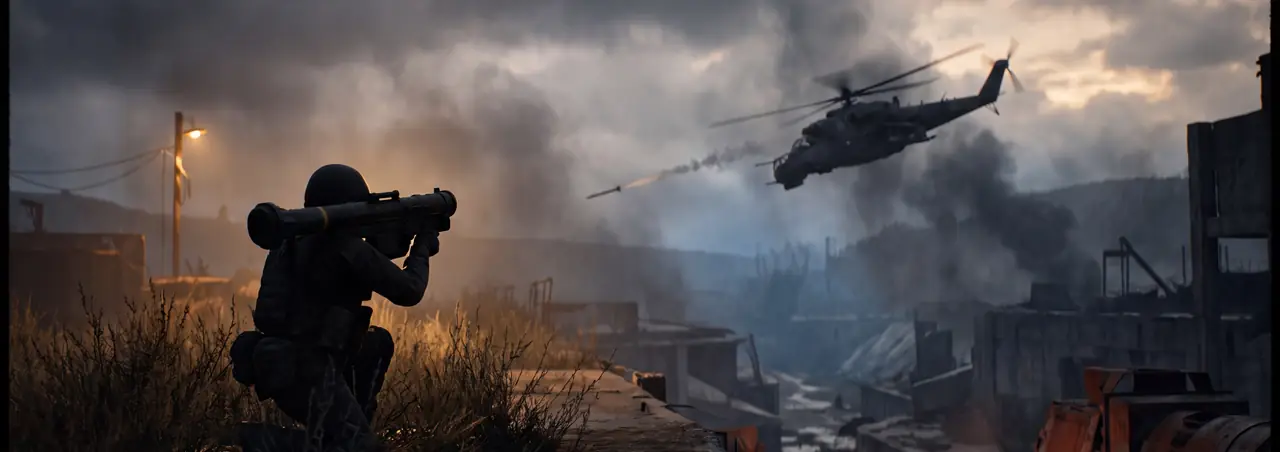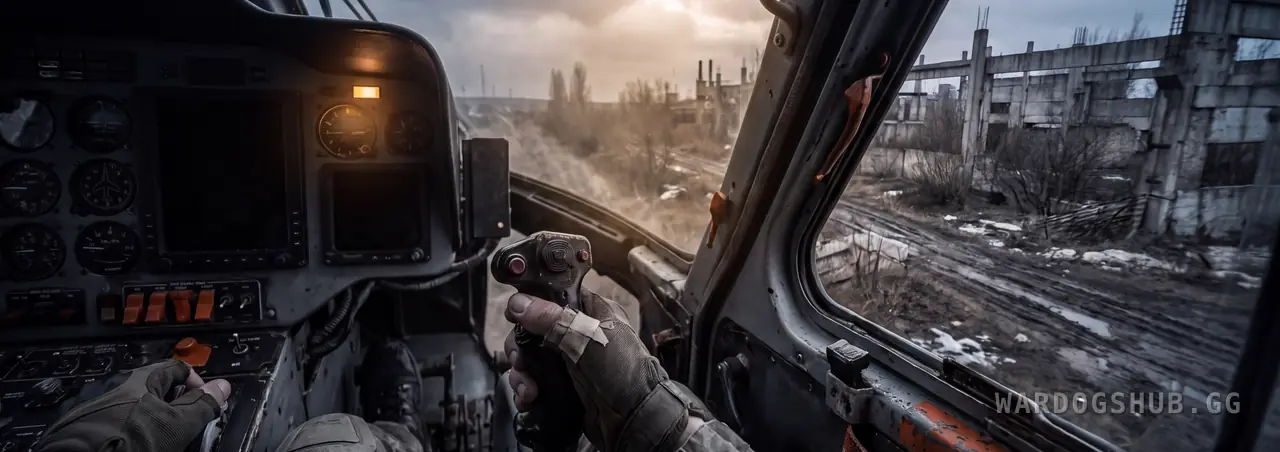
Squad and Arma both make you earn the helicopter, and both assume you will go and learn it somewhere else first. WARDOGS does not. It hands you a flight model with a real collective, puts a hundred players on the map with you, and charges you thousands of dollars every time you put a rotor into a tree.
This is the order to learn it in. It is written for someone who has never flown in a game before, and it is mostly about the two hours where you are bad at it, because that is the part nobody covers.
For what to fly it with — pads, sticks and pedals — we have separate pieces on the best flight stick for WARDOGS, the best controller and how to set a pad up at all. Once you can hover, land and survive a lock, the attack helicopter guide picks up where this one stops.
Start on the MH-6 and learn the collective before you touch anything armed
The single most useful thing to understand on day one is that height and direction are two different controls. The collective is your height. The cyclic is where you are going. In every other shooter you have played, one stick did both.
New pilots crash because they try to steer before they can hold still. The fix is boring and it works:
- Take the cheapest transport, get in, and lift the collective until the skids leave the ground.
- Stay at head height. Do not go anywhere. Hold it there until it stops wobbling.
- Only then push the cyclic forward, and only a little.
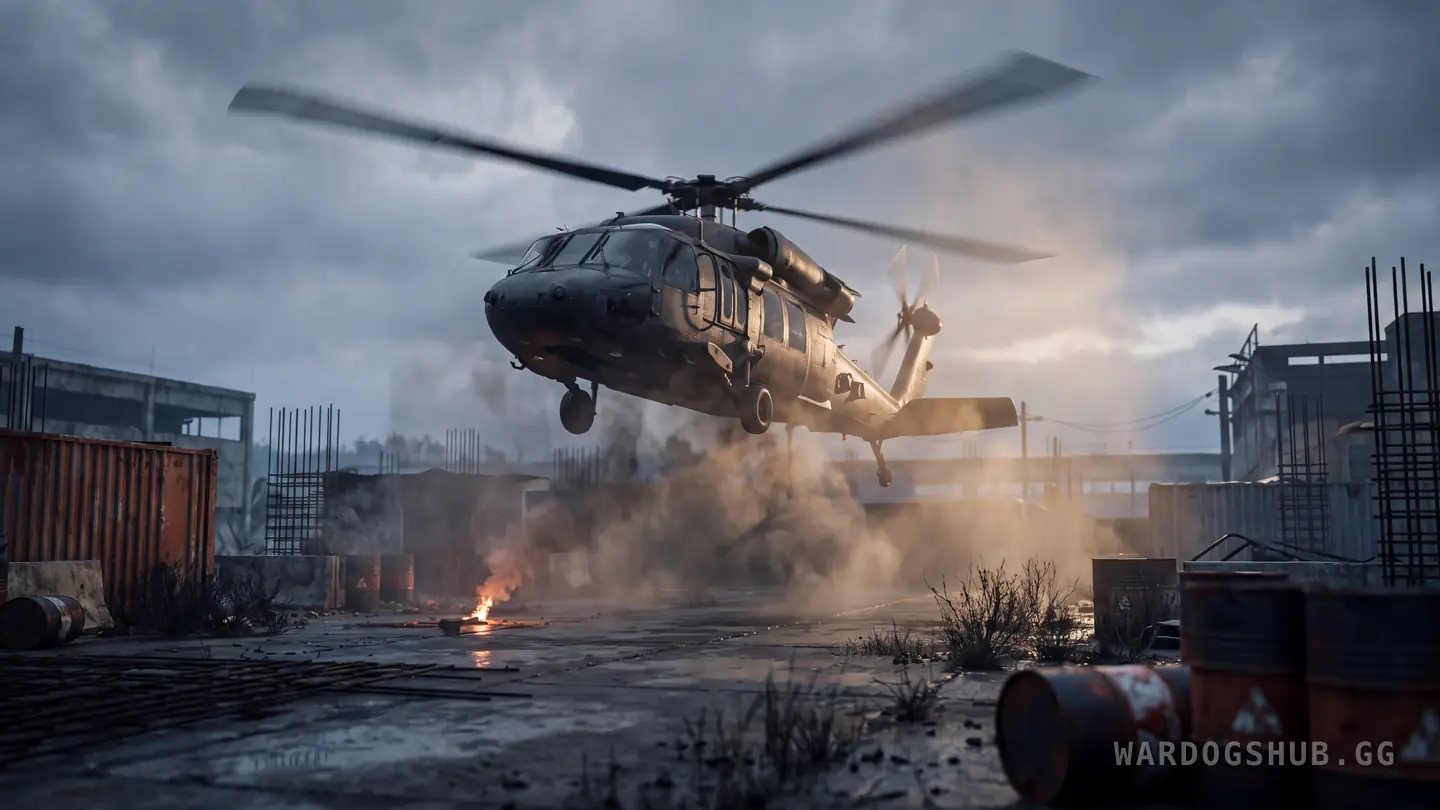
A helicopter that is moving forward is easier to fly than one that is hovering — air moving over the rotor does some of the work for you. That is why pilots who can cross the map still put it in the dirt on landing: the hard part is at both ends, not in the middle.
Land with a slow bleed or a J-hook, never straight down
The landing most new pilots invent for themselves is the worst one available. They race to the landing zone at full speed, realise late, and kill all that speed vertically — a slow, straight descent in full view of everyone nearby. It is the easiest shooting gallery in the game, and your passengers are the targets.
Two landings fix it, and both start before you take off. Plan your route and your landing zone first, and pick something straight to fly the final leg along: a road, a treeline, a fence. Then choose one of these.
The low-speed bleed
The safe one. Line up on your straight path, drop the collective to zero and hold your height by feathering the pitch up. The nose-up attitude sheds speed while the lowered collective stops you climbing. Once you are down to about 50 km/h, set the skids down gently and either come to a stop or slide along the ground on them.
It is slow and it is predictable, which is the trade-off. It is also very hard to get wrong.
The J-hook
The fast one. To hook left, fly in on a line to the right of your landing zone; to hook right, come in to its left. As the zone comes alongside, roll towards it, use your yaw to swing the nose round and let the airframe dump its speed in the turn, then set down.
It takes practice and it needs room to turn, but you spend far less time slow and exposed. It will not be pretty the first dozen times. Your passengers will not care, as long as they walk away.
Your first job is a taxi, and it pays better than it sounds
The instinct is to buy something with rockets. Do not. The transport role is where the money is, and it is where a bad pilot does the least damage to their own wallet.
You get paid for delivering people alive, and — this is the part nobody tells you — you keep earning from them after they get out. Passengers who go on to kill things pay back into the pilot who dropped them there. Add supply drops on top, plus tips, since passengers can hand you cash directly — Bulkhead's own account posted "always tip your pilot" during the beta weekend — and in a game where money persists between matches that compounds.
The reported numbers are not small. Pilots who transport full time describe clearing around 150,000 to 200,000 dollars in a match without firing a shot, and one 13-hour pilot said they had not touched a gun at all. Take the exact figures as beta anecdotes rather than a rule — nobody has published the payout formula — but the direction is not in doubt. Transport is the best-paid thing you can do badly.
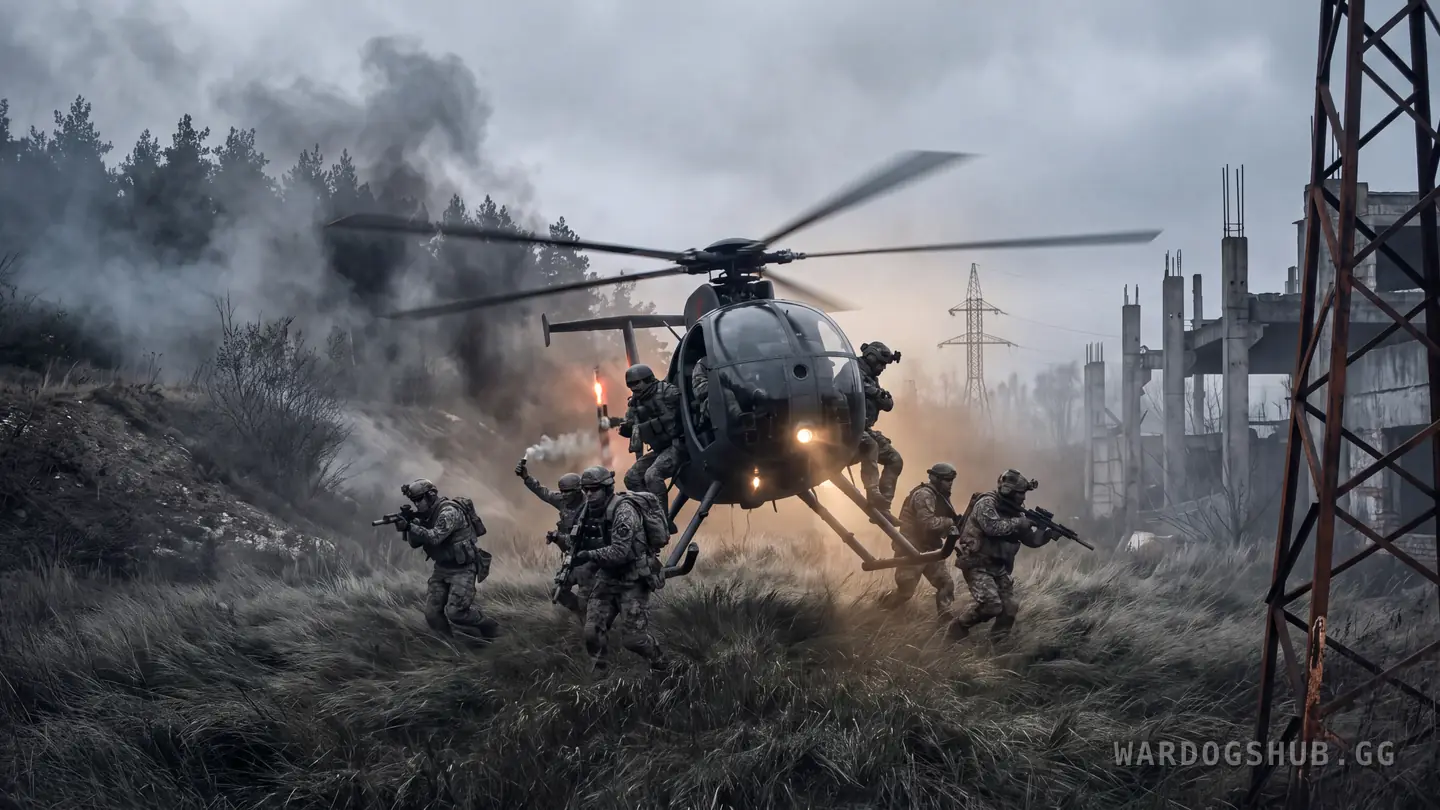
The trade-off is that you are a bus, and buses get shot at. Fly the ridgelines, come in behind your own lines, and put people down behind cover rather than on top of the thing everyone is fighting over. A pilot who drops six players into open ground has cost their team six respawns and their own reputation — and because your income is tied to what those players do next, it costs you twice.
Talk to your passengers, and talk them out of jumping. A player hanging under a parachute is the easiest kill on the server. They cannot dodge, anyone on the ground can hit them, and they land somewhere away from their squad. A squad set down together can heal and revive each other. Six people scattered across a hillside cannot.
There is one payout worth knowing about purely for the comedy: fly through a structure and the game hands you $30 for the trick. There are similar bonuses for air time and for backflips in ground vehicles. As the player who filmed it put it, they made $30 doing it alone and lost thousands showing the team.
Nobody has to get in your helicopter, and some of them will not
The most-argued quality-of-life idea to come out of the beta is a way to tell a good pilot from a brand new one before you climb in — and unusually for a community wishlist item, this one has Bulkhead's own fingerprints on it. On 22 August the studio's CEO and executive producer on WARDOGS, Joe Brammer, floated it in public: "What if there was a hidden Uber rating in the background. What do you think yours is."
Read it as a developer thinking out loud rather than a roadmap entry — but note the word hidden, because it points the opposite way from what players are asking for. The community wants a signal it can see before boarding: pilot level shown above the aircraft at spawn, a star rating given when you hop out, a count of passengers delivered alive. The version that keeps winning the argument is borrowed from Arma Reforger's King of the Hill — a visible insertion streak for your current life, which resets when you die. Not a permanent score, a run of good drops.
The strongest objection is the top comment on the thread, and it is a good one. A rating gates new pilots out of ever becoming good pilots: nobody levels up if everybody waits for the veterans. The answer from pilots is that you do not need passengers to level the role at all, because supply runs pay the same progression. If you are learning, fly crates rather than people until you trust yourself.
Nothing has been announced. A tweet is not a feature, and the shape it would take — hidden or visible, permanent or per-life — is exactly what is still being argued over in the developer forum.
Two things you can do about it today, though.
There is already an accidental vetting signal, and it is the music. Cassette tapes unlock by pilot level, so a pilot playing music out of the aircraft has put the hours in. Players worked that out for themselves before anyone proposed a rating system.
Buy a parachute. Players put it at roughly $100, and it makes the whole question academic — if your pilot goes down, you step out. That is what it is for: a helicopter on its way into the ground, not a healthy one on its way to the landing zone.
What each helicopter costs, and which one to fly first
Prices are the list prices from the Closed Alpha. A New Recruit discount was running throughout, so every figure here is the doubled full price rather than what the tile showed — the methodology page explains that in full, and the helicopter page and the whole vehicle list are priced the same way. Unlock gates are Season 1's, all on the Pilot track.
| Helicopter | Role | Unlock | Price |
|---|---|---|---|
| MH-6 | Transport | — | $6,250 |
| AH-6M | Miniguns | Pilot 4, $50,000 | $7,000 |
| Z20 LAKOTA | Transport | Pilot 10, $35,000 | $7,400 |
| AH-6R | Rockets | Pilot 20, $200,000 | $12,500 |
| Z20 LAKOTA | Miniguns | Pilot 25, $75,000 | $8,000 |
| HAVOC | Attack | Pilot 35, $500,000 | $18,000 |
Fly them in roughly that order. The MH-6 teaches you the flight model with nothing else to think about. The armed Little Birds — the AH-6M with miniguns and the AH-6R with rockets — are the ones players rated most highly during the beta, and at $7,000 a flight the minigun variant is still the cheapest way to find out whether you can shoot and fly at the same time. You almost certainly cannot, at first.
Season 1 swapped two of the gates. The minigun Little Bird's unlock doubled from $25,000 to $50,000, and the Lakota's fell from $50,000 to $35,000 — so the transport now costs less to open than the first gun, even though it sits six levels later.
The HAVOC is the one to be honest with yourself about. $18,000 a flight is nearly three transports, and it sits behind Pilot level 35 and half a million dollars. Losing it once because you flew into a hill you did not see is a bad night. When you get there, the attack helicopter guide covers what it can and cannot kill.
Set up mouse and keyboard the way the best pilots do
There is no single correct control scheme, and the top pilots in WARDOGS fly on all four of them:
- Rifle Aim puts yaw and pitch on the mouse. It has the highest ceiling for precision, and it is the one to start on if you have no habits yet.
- Default leaves yaw on the keyboard. A middle ground, and easier to hold a long, steady yaw on.
- Dual flight sticks give the same precision as Rifle Aim with your hands in a different place.
- HOTAS with pedals is the smoothest to fly and the least precise to aim.
Pick the one that clicks, not the one a better pilot uses. If you fly mouse and keyboard, though, the settings the best pilots have converged on are close to unanimous:
- Turn mouse control on.
- Set the air vehicle sensitivity multiplier to 2.0, with the pitch, yaw and roll multipliers all set very low.
- Bind every mouse axis to keys as well, so you always have a keyboard fallback.
- Fly with no assists, or with auto hover as the only one.
On Rifle Aim you will still need a dedicated yaw key. Some manoeuvres ask for a long, continuous yaw input that a mouse cannot give you comfortably.
Turn off invert mouse for infantry, or your pitch will be backwards
This one is worth checking before you do anything else, because it will make you think you cannot fly when the problem is a settings conflict.
Turning on invert mouse for infantry also reverses helicopter pitch on the X axis. Vertical pitch
behaves normally; horizontal does not. Turning the infantry setting off restores standard helicopter
control. The player who pinned it down, polycroc, tested it both ways during the beta and posted the
result.
Related, and just as annoying: controller players cannot rebind helicopter controls at all, which several experienced Squad and Arma pilots flagged as the reason they gave up on a pad. Our controller guide covers what you can and cannot change. The keyboard side has its own hidden traps too — moving the wrong key breaks a mortar reload or a ladder rather than a helicopter control, and what breaks when you rebind covers those. If you hit something that looks like a crash rather than a control problem, the error and crash pages have the fixes.
Listen for the lock tone, then get below radar
An earlier version of this page said nothing warns you about a missile. That is wrong for the game as it stands. There are two tones, and they mean different things:
- Beeping means a launcher is acquiring a lock on you.
- A hard, steady tone means the lock is complete, and a missile could already be in the air.
Below roughly 10 metres, a lock cannot hold. So the moment the beeping starts, hit the deck. If you are down among the terrain and the steady tone is still there, assume a missile is on its way and fire your flares.
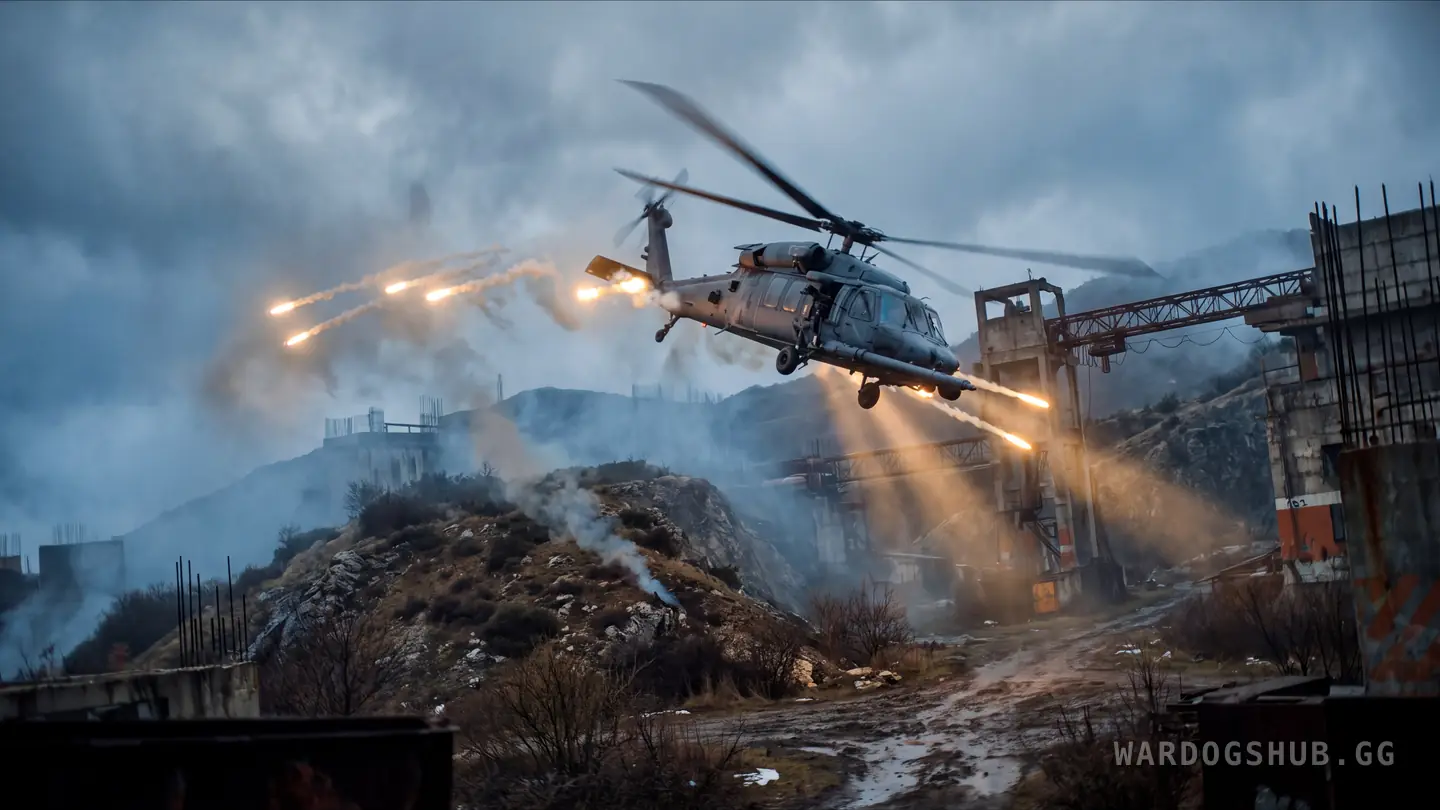
To see the missile itself, use free look in third person. Turn so the safe side of the map — your own lines, a ridge at your back — is the side you are not watching, and spend your free look on the directions a launch could come from. A wider field of view helps here too — see is an ultrawide monitor good for WARDOGS for the trade-off against an infantry fight.
The buildable anti-air was the loudest pilot complaint of the beta. George Hamnond laid out the case
in the developer forum: too much ammunition, missiles that fire in quick succession, and flares that
cannot keep up because of their cooldown. One hidden launcher on a hill could end air power for a
whole team.
So: stay low, stay behind terrain, and never cross open ground at altitude. Height feels safer and is the opposite. Learn where the ridgelines run on each map and treat them as your road network.
The window where pilots decide the match closes when the spawn truck goes up
This is the part that surprises people who learn to fly and then wonder why nobody wants a lift.
Helicopters matter enormously in the opening stretch of a match, when the only way to the fighting is across the map. Once a team gets its mobile spawn vehicle forward, most of that demand evaporates — players spawn at the truck instead of queueing for your rotor. Pilots who want to level the role have a limited window to do it in, and it is at the start.
Two things follow. Be in the air early, because that is when the flights are worth flying. And do not build your whole match around being a taxi, because by the second hour the taxi rank is empty and the useful pilot is the one hauling ammunition to a forward base that is running dry.
Where to practise outside WARDOGS
The transferable skills are collective control and coordinated cyclic-and-pedal work, and the games that teach those are the ones you would expect.
- Arma 3 or Arma Reforger. The closest flight model to what WARDOGS is doing, and by far the most transferable. One long-time Arma and Squad pilot put the mix at roughly 60% Arma, 30% Squad and 10% new, which matches how it feels. Reforger is the cheaper way in.
- Squad. Rotary flight with the same "you are a bus and buses are precious" economy of trust.
- DCS World. Free, and much harder than you need. Useful if you want the fundamentals drilled properly, overkill if you just want to stop crashing.
An OCE community called Pilots Anonymous formed during the beta specifically to share helicopter settings and keybinds between pilots, which tells you how much of this is being worked out collectively rather than documented anywhere. If you have a stick, our flight stick guide covers what binds and what does not.
What we still do not know
Plenty, and it is worth being straight about which parts of the above are firm.
The unlock gates are Bulkhead's own Season 1 table. The purchase prices are ours, recorded first-hand during the Closed Alpha, and nobody has published a newer set. The landing technique, the settings and the lock tones come from pilots flying the Early Access build. The payouts and the invert-mouse bug come from the Closed Beta. None of those has been formally confirmed by Bulkhead.
Nobody has published the exact payout formula for transport, tips or supply runs, the altitude at which a lock breaks, or whether any form of pilot rating ships.
The useful advice is still the boring advice: take the cheap one, learn the hover, land slowly, fly low, and get paid for moving people.